9.7.14.5.16. Warp-level matrix store instruction: stmatrix
stmatrix
Collectively store one or more matrices to shared memory.
Syntax
stmatrix.sync.aligned.shape.num{.trans}{.ss}.type [p], r;

.shape  = {.m8n8, .m16n8};
.num    = {.x1, .x2, .x4};
.ss     = {.shared{::cta}};
.type   = {.b16, .b8};
Description
Collectively store one or more matrices across all threads in a warp to the location indicated by the address operand p, in .shared state space. If no state space is provided, generic addressing is used, such that the address in p points into .shared space. If the generic address doesn't fall in .shared state space, then the behavior is undefined.
The .shape qualifier indicates the dimensions of the matrices being loaded. Each matrix element holds 16-bit or 8-bit data as indicated by the .type qualifier.
.m16n8 shape is valid only for .b8 type.
The values .x1, .x2 and .x4 for .num indicate one, two or four matrices respectively.
The mandatory .sync qualifier indicates that stmatrix causes the executing thread to wait until all threads in the warp execute the same stmatrix instruction before resuming execution.
The mandatory .aligned qualifier indicates that all threads in the warp must execute the same stmatrix instruction. In conditionally executed code, an stmatrix instruction should only be used if it is known that all threads in the warp evaluate the condition identically, otherwise the behavior is undefined.
The behavior of stmatrix is undefined if all threads do not use the same qualifiers, or if any thread in the warp has exited.
The source operand r is a brace-enclosed vector expression consisting of 1, 2, or 4 32-bit registers as per the value of .num. Each component of the vector expression holds a fragment from the corresponding matrix.
Supported addressing modes for p are described in Addresses as Operands.
Consecutive instances of row need not be stored contiguously in memory. The eight addresses required for each matrix are provided by eight threads, depending upon the value of .num as shown in the following table. Each address corresponds to the start of a matrix row. Addresses addr0–addr7 correspond to the rows of the first matrix, addresses addr8–addr15 correspond to the rows of the second matrix, and so on.
.num |
Threads 0–7 | Threads 8–15 | Threads 16–23 | Threads 24–31 |
|---|---|---|---|---|
.x1 |
addr0–addr7 | – | – | – |
.x2 |
addr0–addr7 | addr8–addr15 | – | – |
.x4 |
addr0–addr7 | addr8–addr15 | addr16–addr23 | addr24–addr31 |
When storing 8x8 matrices, a group of four consecutive threads stores 16 bytes. The matrix addresses must be naturally aligned accordingly.
Each thread in a warp stores fragments of a row, with thread 0 storing the first fragment from its register r, and so on. A group of four threads stores an entire row of the matrix as shown in Figure 107.
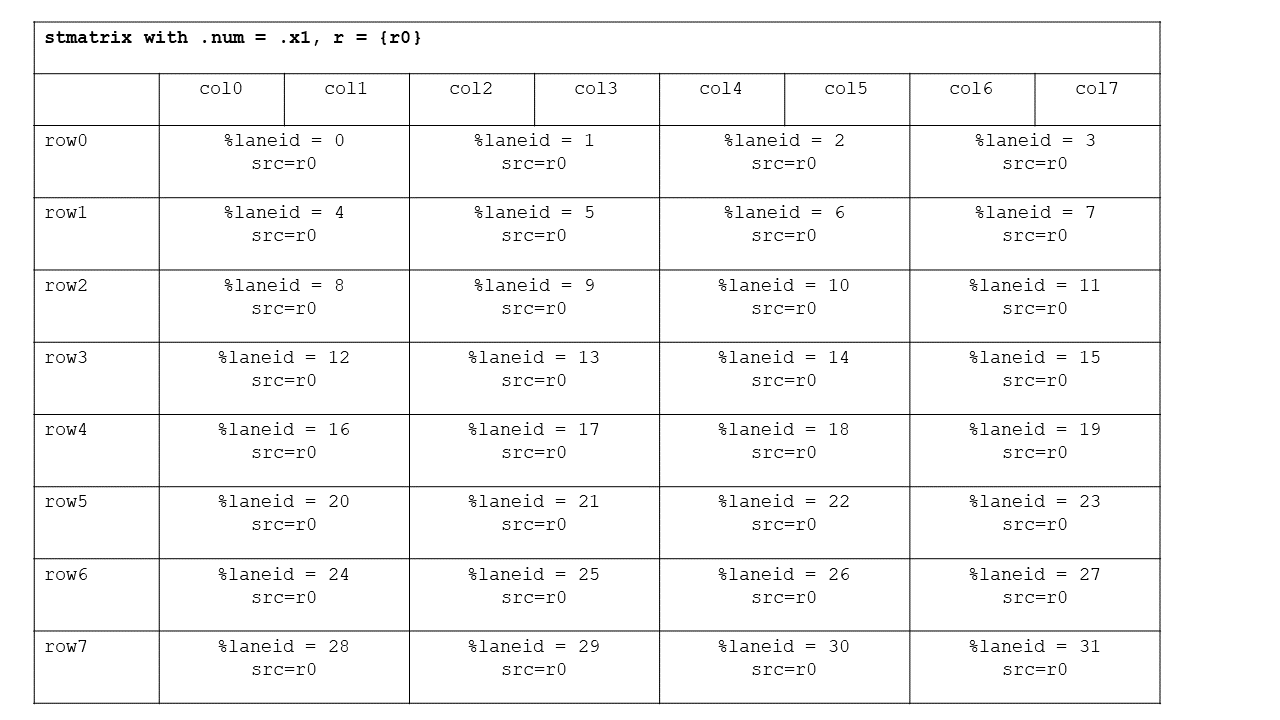
Figure 107 stmatrix fragment layout for one 8x8 matrix with 16-bit elements
When .num = .x2, the elements of the second matrix are storedd from the next source register in each thread as per the layout in above table. Similarly, when .num = .x4, elements of the third and fourth matrices are stored from the subsequent source registers in each thread.
For 16x8 matrix shape, each of the 32 threads in the warp provides four elements of data per matrix.
Each element in the source operand r is of type .b32 and contains four 8 bit elements e0, e1, e2, e3 with e0 and e3 containing the LSB and MSB respectively of register r.

Figure 108 stmatrix fragment layout for one 16x8 matrix with 8 bit elements
Optional qualifier .trans indicates that the matrix is stored in column-major format. However, for 16x8 matrices, .trans is mandatory.
The stmatrix instruction is treated as a weak memory operation in the Memory Consistency Model.
PTX ISA Notes
Introduced in PTX ISA version 7.8.
Support for .m16n8 shape is introduced in PTX ISA version 8.6.
Support for .b8 type with stmatrix is introduced in PTX ISA version 8.6.
Target ISA Notes
Requires sm_90 or higher.
Shape .m16n8 is supported on following architectures:
sm_100asm_101a(Renamed tosm_110afrom PTX ISA version 9.0)sm_120a
And is supported on following family-specific architectures from PTX ISA version 8.8:
sm_100for higher in the same familysm_101for higher in the same family (Renamed tosm_110ffrom PTX ISA version 9.0)sm_120for higher in the same familysm_110for higher in the same family
Type .b8 with stmatrix is supported on following architectures:
sm_100asm_101a(Renamed tosm_110afrom PTX ISA version 9.0)sm_120a
And is supported on following family-specific architectures from PTX ISA version 8.8:
sm_100for higher in the same familysm_101for higher in the same family (Renamed tosm_110ffrom PTX ISA version 9.0)sm_120for higher in the same familysm_110for higher in the same family
Examples
// Store a single 8x8 matrix using 64-bit addressing
.reg .b64 addr;
.reg .b32 r;
stmatrix.sync.aligned.m8n8.x1.shared.b16 [addr], {r};

// Store two 8x8 matrices in column-major format
.reg .b64 addr;
.reg .b32 r<2>;
stmatrix.sync.aligned.m8n8.x2.trans.shared::cta.b16 [addr], {r0, r1};

// Store four 8x8 matrices
.reg .b64 addr;
.reg .b32 r<4>;
stmatrix.sync.aligned.m8n8.x4.b16 [addr], {r0, r1, r2, r3};

// Store a single 16x8 matrix using generic addressing
.reg .b64 addr;
.reg .b32 r;
stmatrix.sync.aligned.m16n8.x1.trans.shared.b8 [addr], {r};

// Store two 16x8 matrices
.reg .b64 addr;
.reg .b32 r<2>;
stmatrix.sync.aligned.m16n8.x2.trans.shared::cta.b8 [addr],{r0, r1};

// Store four 16x8 matrices
.reg .b64 addr;
.reg .b32 r<4>;
stmatrix.sync.aligned.m16n8.x4.b8 [addr], {r0, r1, r2, r3};